
- This event has passed.
Global WaqfTech Conference & Exhibition 2026
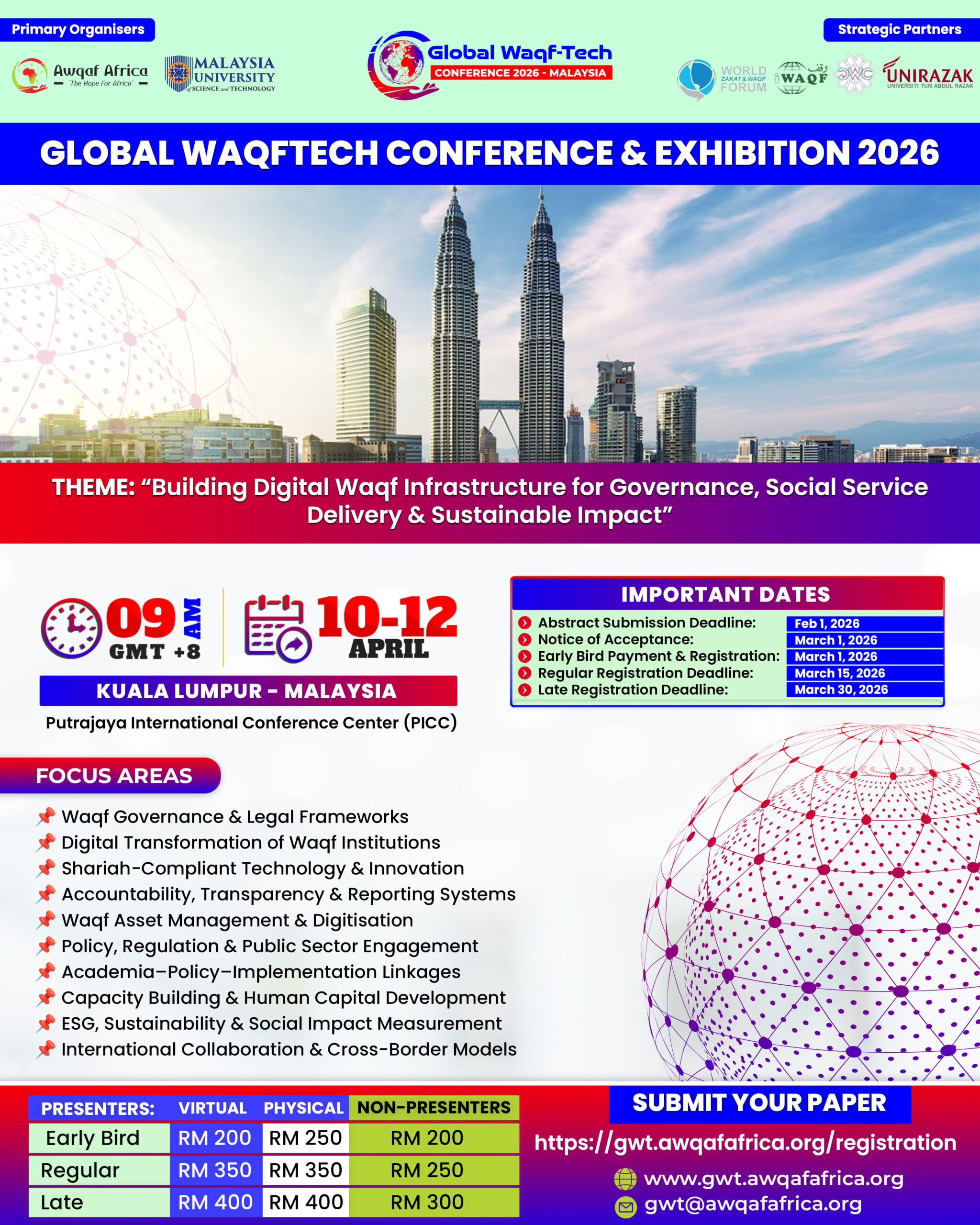
Building Digital Waqf Infrastructure for
Governance, Social Service Delivery & Sustainable Impact
| 10-12 APRIL 2026
Putrajaya International Conference Center (PICC) – KUALA LUMPUR, MALAYSIA |
A Governance-First, Institution-Led International Platform
- INTRODUCTION
The Global WaqfTech Conference & Exhibition 2026 is a governance-first, institution-led international platform convened to address the increasing role of digital systems in waqf, zakat, halal governance, and Islamic social finance.
As institutions across jurisdictions adopt digital infrastructure for asset management, financial reporting, certification, and social service delivery, there is a growing need to ensure that such systems are developed and deployed in alignment with governance, regulatory oversight, Shariah principles, and public trust.
This Conference is established to support that objective.
- CONFERENCE OVERVIEW
| Conference | Global WaqfTech Conference & Exhibition 2026 |
| Theme | Building Digital Waqf Infrastructure for Governance, Social Service Delivery & Sustainable Impact |
| Dates | 10-12 April 2026 |
| Venue | Putrajaya International Conference Center (PICC), Kuala Lumpur, Malaysia |
| Secretariat | Global WaqfTech Conference & Exhibition 2026 |
| IMPORTANT NOTE
The Conference is not a commercial trade fair and not a fundraising event. It is designed as a policy, governance, and institutional capacity-building platform. |
- RATIONALE & CONTEXT
Institutions responsible for waqf, zakat, halal certification, Islamic finance, and public-interest services face converging challenges:
- Rapid digitalisation outpacing governance frameworks
- Fragmented systems and data silos
- Rising expectations for transparency, auditability, and accountability
- Increasing cybersecurity and data protection risks
- The need to align innovation with Shariah, law, and public interest
The Conference provides a neutral institutional space to address these challenges collectively through structured dialogue and governance-aligned engagement.
- OBJECTIVES OF THE CONFERENCE
The Conference aims to:
- Strengthen digital governance and accountability in waqf and related institutions
- Enable technology-assisted oversight and regulatory supervision
- Facilitate cross-border and cross-sector regulatory dialogue
- Support waqf-enabled social service delivery (health, education, social protection)
- Align waqf and halal innovation with national priorities and the SDGs
- Produce documented policy and institutional outcomes
- TEN (10) CORE THEMATIC AREAS
The Conference is structured around ten interrelated, governance-led thematic areas:
| 1 | Digital Infrastructure for Waqf (AI, Blockchain & Smart Contracts) |
| 2 | Financial Inclusion & WaqfTech Innovation |
| 3 | Cybersecurity & Data Protection in Waqf Systems |
| 4 | Regulatory & Compliance Frameworks for Digital Waqf |
| 5 | Ethical AI & Shariah Governance in WaqfTech |
| 6 | Waqf Crowdfunding & Digital Investment Models |
| 7 | Geospatial Systems for Waqf Asset Mapping & Verification |
| 8 | Regulatory Interfaces with Islamic Finance & Halal Governance |
| 9 | Waqf-Enabled Social Service Delivery Systems |
| 10 | Waqf & Sustainable Development Goals (SDGs) |
These themes reflect institutional and regulatory realities, not technology promotion.
- CONFERENCE STRUCTURE
The Conference is delivered over three (3) days, following a deliberate governance flow:
| DAY 1 | Governance, Policy & Regulatory Foundations |
| DAY 2 | Digital Infrastructure, Transparency & Systems |
| DAY 3 | Social Service Delivery, Impact & Global Partnerships |
This structure ensures progression from policy → systems → impact.
- EXHIBITION (INSTITUTIONAL SHOWCASE)
The Exhibition component operates as a curated institutional showcase, designed to complement policy and governance discussions with practical demonstrations of governance-aligned systems and frameworks.
The Exhibition is not a commercial marketplace and does not permit retail sales, fundraising activities, or consumer marketing.
7.1 Exhibition Architecture
The Exhibition is organised across three (3) thematic pavilions, aligned with the Conference’s governance framework:
Digital Waqf Infrastructure Pavilion
Systems supporting waqf governance, asset management, transparency, auditability, and compliance.
Halal, Islamic Finance & Regulatory Systems Pavilion
Governance-aligned systems interfacing waqf with halal certification, Islamic finance infrastructure, and regulatory compliance.
Social Impact, SDGs & Service Delivery Pavilion
Waqf-enabled solutions supporting health, education, social protection, sustainability, and SDG-aligned service delivery.
7.2 Exhibition Scale
| Total curated booths | 50 |
| Pavilions | 3 thematic zones |
| Duration | Continuous across all three conference days |
All exhibitors are admitted on a curated, governance-aligned basis, subject to institutional relevance and programme integrity.
7.3 Exhibition Governance Principles
- No retail or consumer sales
- No fundraising activities
- No product endorsement by the Conference
- No marketing claims implying regulatory approval
- Exhibition content must align with institutional governance objectives
- INSTITUTIONAL PARTICIPATION
The Conference enables engagement by:
| Universities & Academic Institutions
Research exchange, policy contribution |
| Waqf & Zakat Institutions
Governance dialogue, coordination, capacity building |
| Halal Authorities & Ecosystem Bodies
Standards alignment and governance interfaces |
| Banks & Financial Institutions
Compliance, risk, Islamic social finance integration |
| Regulators & Statutory Bodies
Policy leadership and oversight perspectives |
Participation is institutional, values-based, and non-commercial.
- GOVERNANCE & INTEGRITY ASSURANCE
The Conference operates under strict safeguards:
- No fundraising activities
- No endorsement of products or services
- No commercial influence on programme or outcomes
- Formal institutional governance and approval processes
- Neutral, public-interest orientation
| Participation does not imply policy endorsement unless expressly stated. |
- EXPECTED OUTCOMES
Participating institutions may expect:
- Enhanced understanding of digital waqf governance
- Strengthened institutional coordination and networks
- Documented policy and governance insights
- Contribution to long-term institutional capacity building
- Alignment with national development priorities and the SDGs
- CONFERENCE LEADERSHIP
| CONFERENCE CHAIRMAN |
| Prof. Emeritus Dr. Barjoyai Bardai
Provost, MUST University Advisory Board Member, Awqaf Africa |
| CONFERENCE COORDINATOR |
| Ibrahim Abdul Mugis
President, AWQAF AFRICA |
| CONFERENCE SECRETARIAT |
| Global WaqfTech Conference & Exhibition 2026 |
- CONCLUSION
The Global WaqfTech Conference & Exhibition 2026 provides a trusted, governance-first platform for institutions to collectively shape the future of digital waqf, zakat, halal governance, and Islamic social finance systems.
The Conference is intentionally structured to enable meaningful institutional engagement without compromising mandate, neutrality, or governance responsibilities.
| CONTACT
Conference Secretariat Global WaqfTech Conference & Exhibition 2026 https://gwt.awqafafrica.org |